
Meet Galaxy
Your Data Analysis Platform
Open source platform for accessible, reproducible, and transparent computational research. Used by researchers across the globe on free public infrastructure.

How Galaxy Works
From raw data to published results in three steps.
Bring Your Data
Upload from your computer, paste links, or pull from public archives.
Run Your Analysis
Launch curated workflows or build your own from 10,000+ tools — no programming required.
Share & Reproduce
Every step is tracked. Publish datasets, workflows, and complete analysis histories.
Galaxy in Action
Powering large-scale science and training worldwide.
Vertebrate Genomes Project
The Vertebrate Genomes Project uses Galaxy to produce high-quality reference genome assemblies, aiming to cover all 74,000+ vertebrate species. Assembly workflows are freely available on all three public servers.
Learn more →Galaxy Training Network
Free, peer-reviewed tutorials for researchers at every level. The 2025 Galaxy Training Academy brought together 3,500+ participants in the largest biological data analysis training event of its kind.
Explore training →Latest News
View all →Galaxy Europe Goes Ocean: Ready for Ocean Hackathon 2026!
48 hours, ocean data and fresh ideas! Galaxy Europe's Earth System Sciences platform joins the Ocean Hackathon adventure.
ESG4Stars project launched
Efficient start of the ESG4Stars project with kick-off meeting, general assembly and first collaborative working days all in one week
LangChain Text Splitters, the Missing Link when Processing Long Texts with LLMs
Circumvent context window limits of LLMs by splitting long texts into manageable chunks
Upcoming Events
View all →Cite Galaxy
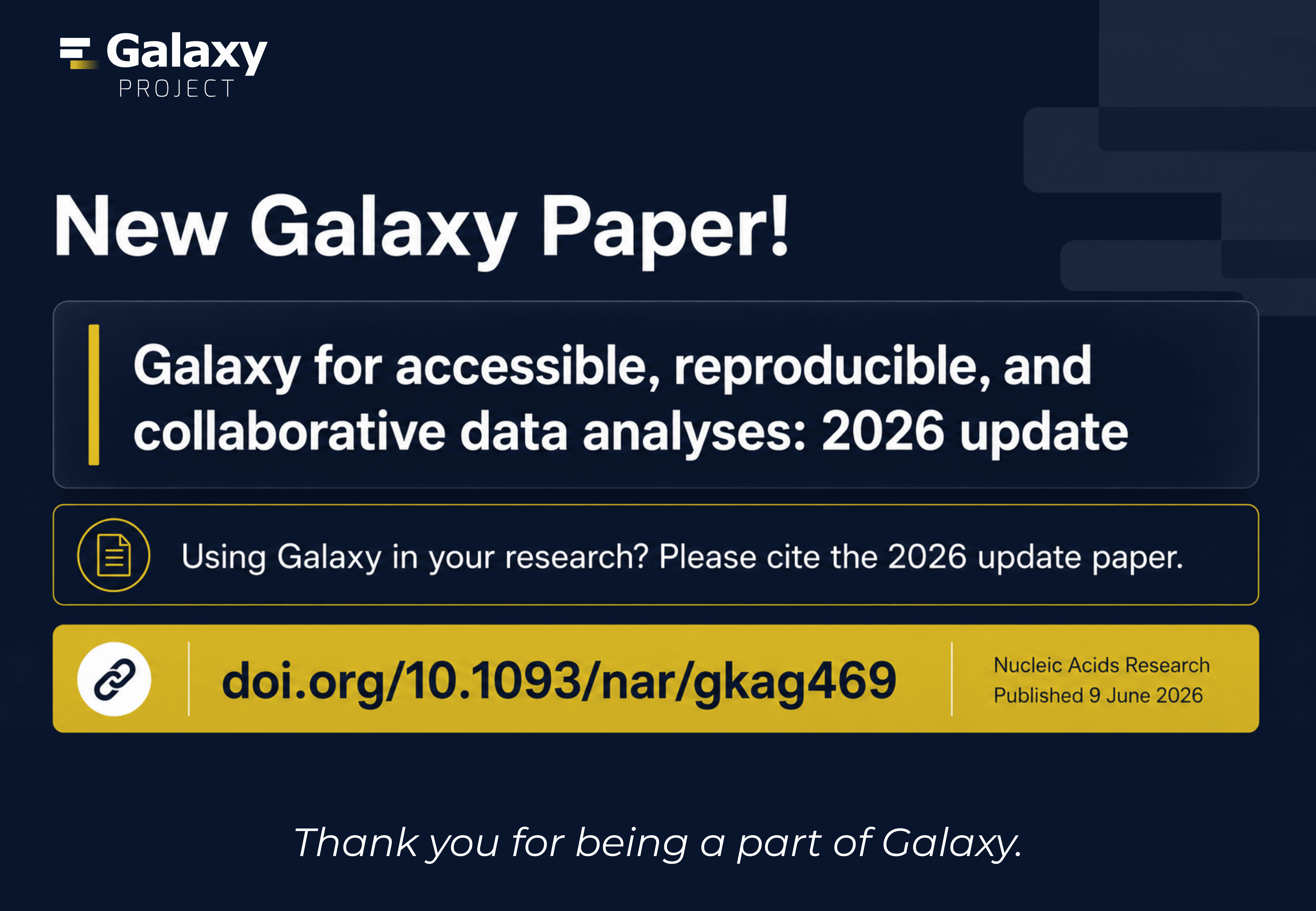
The Galaxy Community. Galaxy for accessible, reproducible, and collaborative data analyses: 2026 update. Nucleic Acids Research, 2026; gkag469, doi:10.1093/nar/gkag469
Full citation guide →